Artificial intelligence is reinventing how businesses answer the phone. AI IVR (artificial intelligence interactive voice response) combines natural language understanding, automation, and real-time decision-making to make every call faster, smoother, and more personal. Insights from Talk Business — Contact Center AI & Omnichannel Support show how AI systems support customers across channels, while Advancements in Virtual Agent Technology highlight how virtual agents deliver instant, accurate help.
Instead of clunky menus and long waits, callers just speak naturally and get answers. For businesses, AI IVR lowers costs, improves satisfaction, and scales operations without hiring endless agents.
Modern businesses also rely on smart technology and computing solutions. Flashmob Computing innovative approaches help teams use computing efficiently, while Supercomputer Box high-performance solutions handle large amounts of data, making AI IVR systems faster and more reliable.
Marketing strategies must evolve alongside technology. Marketing for Customers advanced techniques show how AI IVR supports personalized campaigns and improves engagement, while Marketing Runners digital marketing strategies emphasize combining AI-driven support with marketing efforts to create smoother customer journeys across multiple channels.
Financial planning is also key. Top Financial Resources tech businesses help companies allocate budgets for AI IVR systems while keeping costs under control. This ensures even small teams can scale AI-powered contact centers without sacrificing quality.
By bringing together AI IVR, virtual agents, marketing insights, smart computing, and strategic financial planning, businesses can deliver faster, more personal, and highly satisfying customer experiences. Every call becomes an opportunity to improve service, streamline operations, and create meaningful connections with customers.
Top AI IVR Contact Center Solutions for 2025
Looking to optimize your customer support with AI-powered tools? Here’s a list of the top AI IVR and contact center solutions that help businesses streamline calls, improve customer satisfaction, and scale efficiently.
1. Bright Pattern – Advanced AI Contact Center Solutions
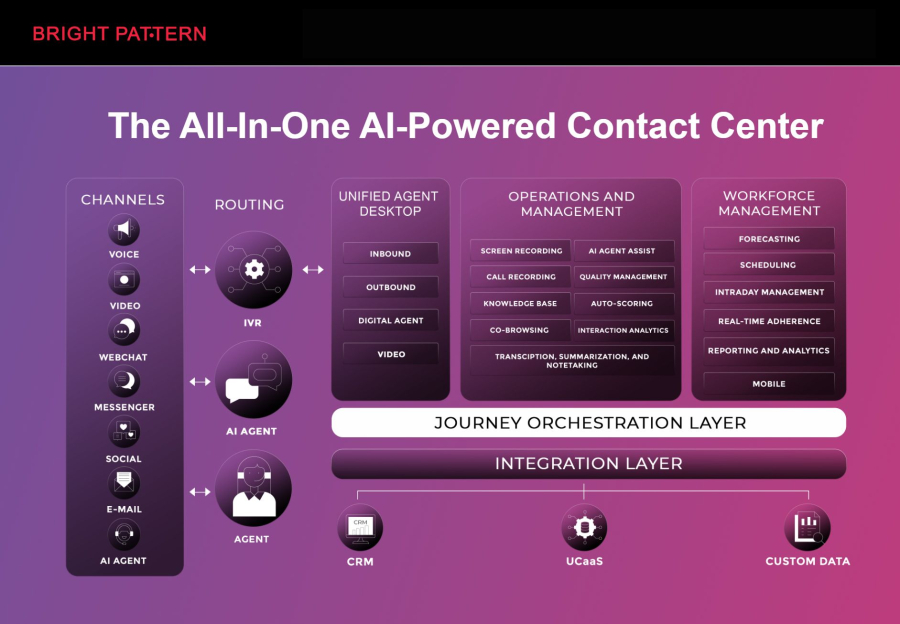
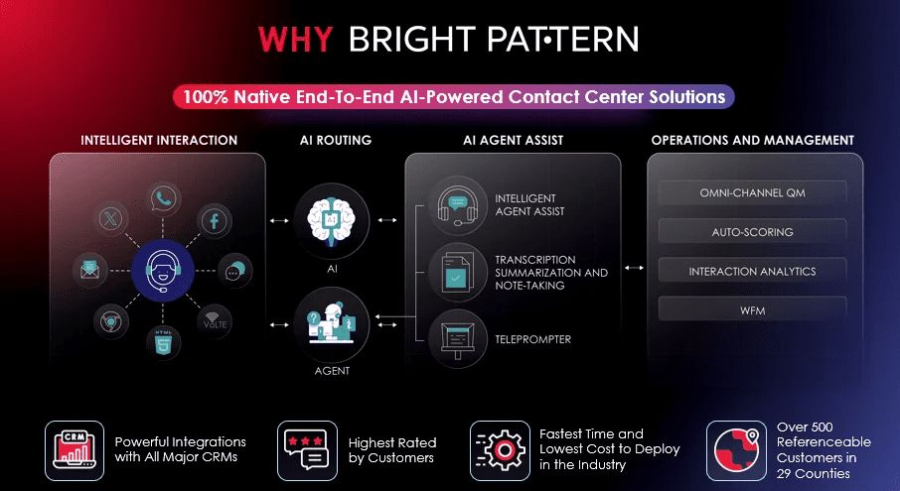
Bright Pattern is a leading AI contact center platform, providing robust AI IVR capabilities that transform customer interactions. Their solution combines conversational IVR, omnichannel routing, and intelligent automation to improve agent efficiency and customer satisfaction.
Key features include:
- Conversational AI IVR that understands natural language
- Omnichannel support across voice, chat, email, and social media
- Real-time analytics and reporting for better decision-making
- Easy integration with CRM and business tools
- Scalable platform that grows with your business
Businesses using Bright Pattern can reduce call handling times, enhance self-service options, and provide personalized customer experiences without adding more agents. The platform is ideal for companies looking for flexible, AI-driven call center solutions that adapt to modern customer expectations.
2. Five9 – Cloud-Based Contact Center Solutions
Five9 offers cloud contact center software with AI IVR features, helping companies automate call routing and improve customer interactions. Their platform focuses on intelligent engagement and predictive analytics.
3. Genesys – Omnichannel Customer Experience
Genesys provides AI-powered IVR and cloud contact center solutions designed to create seamless customer experiences across multiple channels. They emphasize personalization and AI-assisted workflows.
4. NICE inContact – AI Contact Center Platform
NICE inContact delivers AI-driven call center solutions, including automated IVR, chatbots, and workforce optimization tools to improve efficiency and customer satisfaction.
5. Talkdesk – Intelligent Cloud Contact Center
Talkdesk uses AI IVR and virtual agent technology to streamline customer support. Their solution integrates with CRM systems and offers advanced reporting for data-driven decisions.
6. 8x8 – Unified Communications with AI IVR
8x8 provides cloud contact center solutions with conversational AI IVR that enhances call routing, customer self-service, and real-time insights.
7. Avaya – Contact Center AI Solutions
Avaya combines AI IVR, automation, and analytics to deliver smart contact center solutions that reduce wait times and improve the quality of customer interactions.
8. RingCentral – Cloud Contact Center Platform
RingCentral offers AI-driven IVR and omnichannel support, helping businesses streamline communications and provide a consistent customer experience.
9. Vonage – AI-Enabled Contact Center Solutions
Vonage’s contact center platform leverages AI IVR and analytics to optimize call routing, improve agent performance, and enhance customer satisfaction.
10. Cisco – Intelligent Customer Experience Solutions
Cisco provides AI IVR and cloud contact center solutions that integrate voice, chat, and digital channels, enabling businesses to deliver efficient and personalized support.
What Is AI IVR?
AI IVRis an intelligent call-handling system that uses technologies like speech recognition, natural language processing (NLP), and machine learning to understand callers, respond in real time, and route or resolve calls automatically.
Traditional IVR systems rely on rigid, menu-based prompts like “Press 1 for sales, press 2 for support.” AI IVR goes further. Callers can say things like “I want to change my shipping address” or “I’d like to reschedule my appointment” and the system understands their intent and takes the right action.
Key components of AI IVR
- Speech recognition (ASR)that converts spoken words into text.
- Natural language understanding (NLU)that interprets what the caller means, not just what they say.
- Dialogue managementthat decides the next best question, prompt, or action.
- Text-to-speech (TTS)that responds to callers in a natural, human-like voice.
- Integrationswith CRMs, ticketing tools, payment gateways, and core business systems.
AI IVR vs. Traditional IVR: What Has Changed?
AI IVR builds on the foundation of traditional IVR, but the experience for both customers and agents is completely different.
| Aspect | Traditional IVR | AI IVR |
| Caller interaction | Touch-tone menus and limited voice commands. | Natural, conversational speech; callers describe needs in their own words. |
| Flexibility | Static trees; every change requires manual reconfiguration. | Dynamic paths that adapt to caller intent, history, and context. |
| Accuracy | Prone to zero-touch errors and misrouted calls. | Machine learning improves recognition and routing over time. |
| Personalization | Little or no personalization beyond language selection. | Recognizes customers, recalls past interactions, and tailors options. |
| Self-service capabilities | Basic balance checks and simple routing. | End-to-end workflows like payments, bookings, account updates, and more. |
| Agent workload | High, with many repetitive calls. | Lower, as routine tasks are automated and agents focus on complex cases. |
Core Benefits of AI IVR for Your Business
Modern organizations adopt AI IVR because it delivers measurable improvements across cost, customer experience, and efficiency.
1. Drastically reduced wait times
AI IVR handles many requests instantly, without needing a human agent. Routine tasks such as order tracking, password resets, appointment reminders, or balance inquiries can be completed in seconds.
- Fewer callers placed on hold.
- Peak-time traffic managed automatically.
- Shorter queues for customers who truly need a live agent.
2. Round-the-clock availability
Customers expect support 24 / 7. With AI IVR, your phone line never closes. The system can solve common issues and route urgent calls at any time, improving satisfaction while controlling staffing costs.
- Support outside business hours without adding night-shift teams.
- Consistent quality of service, day and night.
- Better experience for global customers in different time zones.
3. Higher first-call resolution rates
Because AI IVR understands natural language and connects with your back-end systems, it resolves many issues in a single call. When escalation is needed, it passes detailed context to agents, so customers do not have to repeat themselves.
- Fewer transfers between departments.
- Less frustration from repeating information.
- More efficient use of skilled agents for complex support needs.
4. Lower operational costs
Every call that AI IVR resolves or helps to streamline reduces the workload on your team. This leads to more efficient staffing, fewer overtime hours, and higher capacity without expanding headcount.
- Automates high-volume, low-complexity interactions.
- Reduces onboarding and training burden for new agents.
- Improves consistency, reducing costly errors and rework.
5. Scalable customer experience
Seasonal spikes, product launches, and unexpected incidents often overwhelm traditional call centers. AI IVR scales automatically, handling more calls in parallel without hurting service quality.
- Accommodates sudden surges in demand.
- Supports growth without linear increases in staffing.
- Maintains service levels even during peak events.
6. Rich analytics and continuous improvement
AI IVR does more than handle calls. It generates detailed insights into customer behavior, preferences, and pain points. These insights help teams refine scripts, improve processes, and uncover new automation opportunities.
- Identify most common intents and issues.
- Spot patterns in call outcomes and abandonment.
- Measure performance with metrics like containment rate and average handle time.
How AI IVR Works in Practice
Behind every smooth, conversational AI IVR experience is a structured flow designed to guide callers to fast resolution.
Step-by-step call flow
- Call initiation– The caller dials your number and is greeted by the AI IVR with a short, friendly welcome message.
- Intent capture– Instead of forcing callers through menus, the system asks an open question like “How can I help you today?” and listens to the caller’s natural response.
- Intent recognition– Using speech recognition and NLU, the system identifies the caller’s intent, such as “track my order” or “update my billing address.”
- Authentication– If needed, the AI IVR verifies identity using information like a customer number, date of birth, or one-time code.
- Action execution– The system connects to your internal tools, retrieves or updates data, and completes the requested task automatically.
- Confirmation and closure– AI IVR confirms what has been done, offers next steps or additional help, and closes the interaction or transfers to a human if necessary.
Real-world scenario examples
- Order tracking– A customer calls and says, “I want to check my order status.” The IVR recognizes the intent, asks for an order number, consults your order management system, and provides a delivery update in seconds.
- Appointment scheduling– A patient calls a clinic saying, “I need to reschedule my appointment.” The IVR verifies identity, offers available time slots, confirms the new date, and sends a confirmation message.
- Bill payment– A subscriber says, “I want to pay my bill.” The system confirms the owed amount, securely processes payment via your payment gateway, and shares a confirmation number.
Top AI IVR Use Cases Across Industries
AI IVR brings value wherever high call volumes and repeatable requests appear. Here are some leading use cases by industry.
Banking and financial services
- Balance inquiries and transaction history.
- Card activation, deactivation, and replacement requests.
- Loan status updates and application guidance.
- Fraud alerts and account security verification.
Retail and e-commerce
- Order status and tracking information.
- Returns, exchanges, and refund updates.
- Store hours, locations, and inventory availability.
- Loyalty program balance and rewards inquiries.
Healthcare and clinics
- Appointment scheduling, rescheduling, and cancellations.
- Pre-visit instructions and reminders.
- Insurance information capture and verification.
- Prescription refill requests and status updates.
Telecommunications and utilities
- Service activation and basic troubleshooting steps.
- Outage reporting and estimated restoration times.
- Plan changes, upgrades, and add-on activations.
- Usage inquiries and billing explanations.
Travel, hospitality, and transport
- Flight, train, or bus schedule information.
- Booking confirmations and itinerary changes.
- Check-in assistance and status updates.
- Frequently asked questions about baggage, policies, or amenities.
Designing a Customer-Friendly AI IVR Experience
To unlock the full benefits of AI IVR, the experience must be thoughtfully crafted around real customer needs. A well-designed solution feels natural, efficient, and helpful.
Use natural, concise prompts
Good AI IVR design starts with clear and friendly prompts. Avoid long monologues and jargon. Instead, keep instructions short and use everyday language that customers recognize immediately.
- Open with a simple welcome and a direct question.
- Explain briefly what callers can ask for.
- Offer confirmation and guidance at each major step.
Design around intents, not menus
Traditional IVR design often mirrors organizational silos. AI IVR works best when it is organized aroundcustomer intentssuch as “make a payment,” “update details,” or “get support,” rather than internal department names.
- Map out the top reasons people call your business.
- Create clear, end-to-end journeys for each intent.
- Automate the entire path wherever possible.
Always offer a path to a human agent
Even the best AI IVR cannot replace human empathy in every situation. Giving customers an easy way to speak to a live agent builds trust and reduces frustration.
- Offer escalation options when the system is unsure.
- Transfer with full context so customers avoid repeating information.
- Use AI IVR as a smart front door, not a barrier.
Continuously train and refine
AI IVR improves over time. By reviewing call logs, analyzing misrecognized intents, and collecting feedback, you can tune the system for higher accuracy and better experiences.
- Regularly review performance metrics and call transcripts.
- Update training data to cover new phrases and use cases.
- Refine prompts and flows based on real behavior.
Key Metrics to Track for AI IVR Success
Measuring the right metrics helps you quantify the value of AI IVR and guide ongoing improvements.
1. Containment rate
This measures the percentage of calls that AI IVR resolves without needing to transfer to an agent. A higher containment rate usually indicates effective automation, but it should never come at the expense of customer satisfaction.
2. Average handle time (AHT)
AI IVR can lower handle times by quickly gathering information and performing actions. Combine AHT data for AI-assisted and human-handled calls to see how much time your automation saves.
3. First-call resolution (FCR)
FCR shows how many issues are solved in a single contact. With AI IVR, strong FCR numbers signal that your intents and flows are aligned with real-world needs.
4. Customer satisfaction (CSAT) and Net Promoter Score (NPS)
Integrate short surveys at the end of calls to measure how customers feel after interacting with AI IVR. Track CSAT and NPS over time to see the long-term impact on loyalty.
5. Call volume and peak-time performance
Monitor daily and seasonal call volume trends. AI IVR should reduce queuing during peak hours and absorb growth without compromising service levels.
Implementation Roadmap: How to Get Started with AI IVR
Launching AI IVR does not have to be overwhelming. A phased, focused approach keeps risk low and impact high.
Step 1: Define goals and success criteria
Begin by clarifying what you want AI IVR to achieve for your business.
- Reduce average wait times by a specific percentage.
- Boost self-service usage for a defined set of use cases.
- Improve FCR or CSAT by measurable margins.
Step 2: Identify high-impact use cases
Analyze call logs to find the most frequent and repetitive interactions. These are prime candidates for automation.
- Start with 3 to 5 high-volume intents.
- Choose tasks that do not require complex judgment.
- Prioritize journeys that use predictable data from your systems.
Step 3: Integrate with existing systems
To deliver end-to-end experiences, AI IVR must connect with your core tools, such as your CRM, billing system, booking platform, or order management solution.
- Work with internal IT teams to define secure access.
- Clarify data flows, from caller input to system updates.
- Ensure compliance with data protection and privacy regulations.
Step 4: Design and test call flows
Map out conversational flows for each intent, including alternatives and edge cases. Then test them thoroughly with internal users before a full rollout.
- Create scripts for greetings, clarifications, and confirmations.
- Include fallback prompts for when the system does not understand.
- Gather feedback from employees and pilot customers.
Step 5: Launch gradually and optimize
Consider a staged launch, enabling AI IVR for a subset of callers or limited use cases first. Use early data to refine and then expand.
- Monitor performance daily in the early weeks.
- Adjust prompts, routing, and decision logic quickly.
- Scale to more use cases as confidence and results grow.
Empowering Agents with AI IVR, Not Replacing Them
AI IVR is most powerful when it works alongside human agents. The goal is not to remove people from the process, but to let them focus where they add the most value.
Offloading repetitive tasks
By handling simple inquiries and data collection, AI IVR frees agents from repetitive work. Agents can then dedicate their time to complex, emotional, or high-value cases that demand human empathy and decision-making.
Providing context-rich transfers
When AI IVR hands a call to a live agent, it can pass along everything it has collected so far: caller identity, intent, previous steps, and relevant data. This shortens the conversation and helps agents deliver more confident, personalized support.
Improving agent satisfaction
With fewer routine calls and better context, agents experience less stress and burnout. They can use their skills more fully, creating a more rewarding work environment and better outcomes for customers.
The Strategic Advantage of AI IVR
Adopting AI IVR is more than a technology upgrade. It is a strategic shift towards smarter, more scalable customer engagement. Organizations that move early can set a new standard for fast, frictionless support that competitors struggle to match.
By combining conversational AI, intelligent automation, and deep integration with your existing systems, AI IVR turns every phone call into an opportunity to impress customers, streamline operations, and grow more efficiently.
For businesses serious about customer experience, AI IVR is quickly moving from a nice-to-have to an essential capability.
Conclusion: Turning Every Call into a Better Experience
AI IVR transforms the classic call center challenge into a growth opportunity. It gives customers faster answers, more control, and a smoother experience, while your business gains lower costs, better data, and the ability to scale with confidence.
When thoughtfully designed and continuously improved, AI IVR becomes the intelligent front door to your organization, welcoming every caller with speed, clarity, and personalized support.
As expectations for effortless service keep rising, AI IVR positions your business to meet those expectations today and stay ahead of them tomorrow.
